
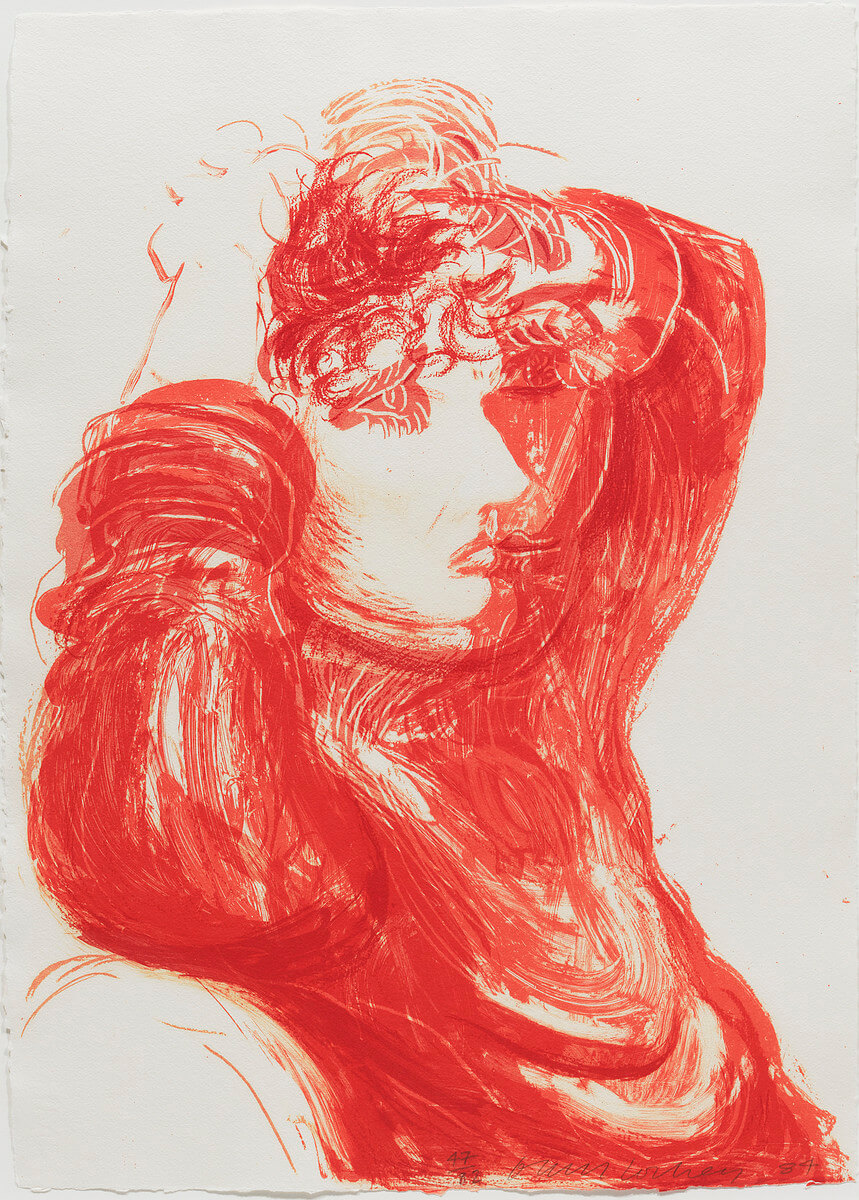
The Nassau County Museum of Art will present Seeing Red: Renoir to Warhol, a major exhibition that reveals the many meanings, connotations, and associations of this powerful color in art.
Evoking strong emotion, red can represent the human condition. Its myriad variations have come to signify authority as well as love, energy, and beauty. Red warns us of peril and commands us to stop, but it can also indicate purity and good fortune. Red boldly represents political movements and religious identities. From the advent of our appreciation for this color in antiquity to its continued prominence in artistic and popular culture, this exhibition will span various world cultures through a range of media.
The exhibition will feature more than 70 artists, both established and emerging, ranging from the classical to the contemporary. American portraitists such as Gilbert Stuart imbued red in their stately paintings of prominent individuals to conjure authority. Robert Motherwell, Ad Reinhardt, and other major abstract painters displayed a deep fascination with red in their commanding compositions that evoke a sense of chromatic power. Alexander Calder prominently employed red in his two-dimensional works and in the mobiles for which he is most famous. Andy Warhol frequently used red in his artworks, from his bold and imposing silkscreened portrait of Vladimir Lenin saturated in bright red to his signature Campbell’s Soup Cans.
Artists today continue to captivate us with their interpretations of red through multiple perspectives. As Josef Albers wrote in 1963, “If one says ‘Red’ — the name of the color — and there are fifty people listening, it can be expected that there will be fifty reds in their minds. And one can be sure that all these reds will be very different.”
- Franklin Hill Perrell, Chief Curator
- Alex C. Maccaro, Assistant Curator


